
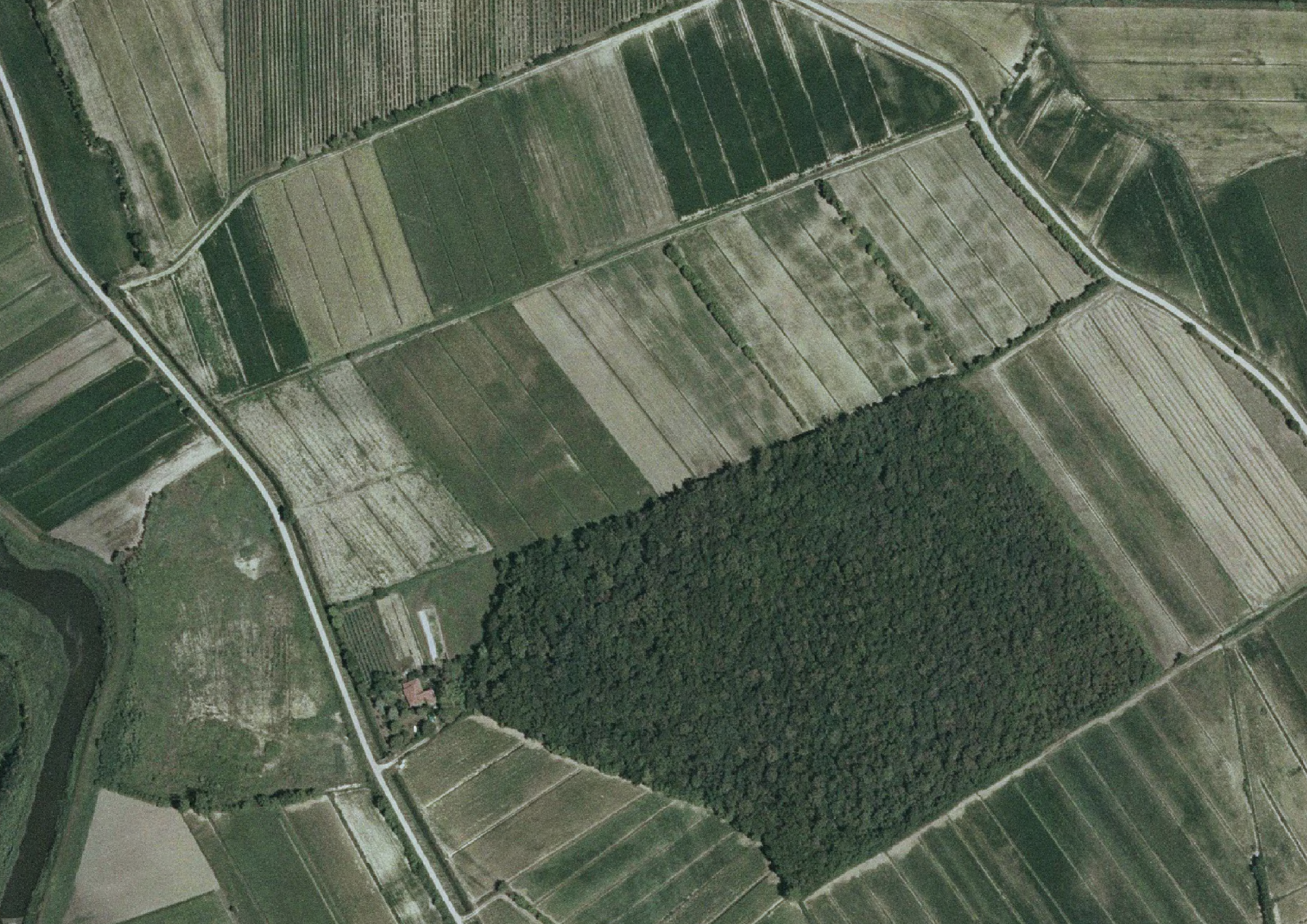
The topography of alluvial plains in Europe has been strongly affected and overprinted by different diachronic human activities, and modern land use has reworked geomorphological and archaeological traces, often hindering the reconstruction of past landscapes and the assessment of ancient environmental impacts. In this work, set in the distal Venetian-Friulian Plain, in northeastern Italy, we took advantage of the presence of the last remnants of semi-natural lowland forests, and we combined high-resolution remotely sensed data to detect and map a specific type of archaeological trace related to clay quarrying. Analysis of digital terrain models (DTMs) obtained from LiDAR (Light Detection And Ranging) revealed topographic traces underneath forested or recently deforested areas while photointerpretation of satellite and aerial imagery was crucial in detecting levelled traces. Moreover, we used hand augering techniques to assess the depth and infill material of the clay quarry evidence. Our investigation recognized nine Roman sites, consisting of hundreds of quadrangular pits (124.8 m2 size – 1 m depth), which lie on top of Last Glacial Maximum (LGM) alluvial clays. We infer these pits to be Roman quarried workshops connected to nearby kilns, where clays were extracted for ceramic building material (CBM) and pottery production. The unique signature of such traces, coupled with their resilience in the highly anthropized study area, underlines a Roman proto-industrial impact on the landscape, and suggests the existence of similar evidence in other plains under the Roman domain.


 pastlands.org